by Sheryl Gottschall © 2025
If you’re like me, at some point in your UFO quest you probably pondered how much the UFO phenomenon has played a part in the establishment of various spiritual and religious organizations and their beliefs. You might have found yourself asking – are angels actually aliens? and are ETs the gods of our ancient past? After all, many groups have been founded around an individual or individuals who had some type of encounter with a being from ‘elsewhere.’
Beings from Elsewhere
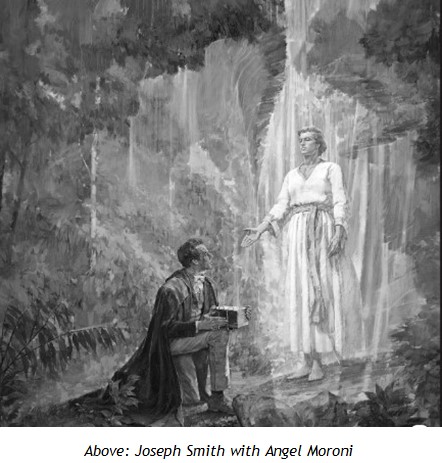
For example, in 1820 Joseph Smith reported he had a vision of God the Father and Jesus Christ in a wooded area near his home in New York. He later claimed that an angel named Moroni visited him and directed him to golden plates buried in a hill. These plates were said to contain ancient writings which Smith translated into the ‘Book of Mormon.’
In 1917, at Cova da Iria in Portugal, three children tending sheep witnessed a flash of lightning in the sky, followed by a vision of a lady standing atop an oak tree. The Catholic community later interpreted this apparition as ‘Our Lady,’ and it became a central part of the Marian visions associated with Fatima. In the Book of Ezekiel, the prophet describes a dramatic vision while in exile by the Kebar River where he sees a glowing cloud with flashing fire, four living creatures with multiple faces and wings, and wheels within wheels beside them, full of eyes appearing in a brilliant radiance.
But could these beings have been of extraterrestrial origins?

These examples show how experiences described in religious texts may be reinterpreted through a modern technological or extraterrestrial lens, suggesting potential non-divine origins for some spiritual encounters. In an age where humanity peers deeper into the universe than ever before, the reimagining of the opening line of the Lord’s Prayer invites us to contemplate the intersections between religion, science fiction, space exploration, and the innate human yearning for transcendence.
Rewriting the Heavens
Traditionally, the invocation ‘Our Father Who Art in Heaven’ has grounded believers in the idea of a celestial deity residing in a spiritual realm beyond our human understanding. But what happens when our concept of ‘heaven’ expands beyond ancient cosmologies into galaxies, wormholes, and the observable universe? This invocation speaks to a generation raised not just on scripture, but also on Man landing on the Moon, Star Trek, Interstellar, and Elon Musk’s Mars colonization dreams, reinventing the search for God not in the clouds, but among the stars. In so doing could the search for our true divine spark be found in star drives, neural networks, and interstellar communion?
Aliens as Gods
The phrase ‘Our Father Who Art in Spaceships’ evokes one of the most tantalizing ideas in theology and science fiction alike: that advanced extraterrestrial life could be perceived as divine. If we encountered beings of higher consciousness, advanced morality, and godlike power, would we not fall to our knees in reverence as we have seen occur in the past and even in our current times? Would our ancient stories of angels, gods, and celestial visitations not find new meaning? To state ‘Our Father Who Art In Spaceships’ is to entertain the idea that God might one day arrive not on a chariot of fire, but on an interstellar craft, speaking in quantum physics among shimmering lights. The idea that aliens might be regarded as gods is one of the most provocative intersections of theology, philosophy, and speculative science. It forces us to confront the nature of divinity itself: is a god defined by power, by knowledge, by moral superiority – or simply by being incomprehensibly beyond us?
Imagine the arrival of an extraterrestrial intelligence, beings so far advanced in technology and consciousness that their presence seems miraculous. With abilities to manipulate space-time, heal disease, or interface directly with thought, they might appear to some as omniscient or omnipotent. Would some, in awe and fear, fall to their knees as ancient humans once did before lightning storms and eclipses? Would religious reflexes, honed over millennia, be triggered once more by the appearance of the seemingly divine?
Such a scenario reframes our oldest myths. Stories of gods descending from the heavens, angels bearing messages from above, or wheels of fire appearing in the sky may no longer be relegated to metaphor or superstition, but reinterpreted as
fragmented memories of ancient contact. The gods of old, radiant, commanding, mysterious, could be echoes of past visitations by intelligences not yet understood. Our sacred texts may become, in this light, less symbolic theology and more distorted cosmology.
To ask ‘Our Father Who Art In Spaceships?’ is not mere irreverence – It is a serious philosophical inquiry dressed in irony. It suggests that the divine might one day emerge not from burning bushes or thunderous clouds, but from the stars themselves, speaking in equations and energy. The chariots of fire become shimmering crafts of interstellar origin; the burning halo, a warp field; the voice of God, a transmission through quantum resonance. If consciousness is the foundation of the universe, as some physicists and mystics have proposed, then the line between alien and angel, advanced species and celestial beings, may blur. As a consequence, the idea of aliens as gods would act as a reminder that the divine may not be behind us in myth, but ahead of us in the stars.
Spaceships as Modern Day Temples
Consider the spaceship not just as a vessel of transport or exploration, but as a modern temple. I have spoken to various people over the last few decades who have their bags packed ready for the aliens to pick them up and take them home. They believe that ET contact is the world’s only hope in the insanity that appears to prevail our world today, and sometimes I fall into that well of despair too. But I don’t think for a minute that ETs are our saviors or that they will ‘fix’ things on planet Earth to change it to the Utopian paradise of our dreams.
Akin to individuals called by the spirits to their shamanic initiation, when inside the spaceship some experiencers have reported confronting unknown ‘others’, enduring medical examinations, having cellular samples removed, then returned to their point of origin (or near enough), and being left to seek meaning in their experiences. A lucky few have experienced revelations so profound that their future gazing into the cosmos is as spiritual as any religious ritual brimming with profound internal shifts in their perspective….about everything!
The Strange Face of Heaven
Wondering about the phrase ‘Our Father Who Art in Spaceships’ ultimately acts as a mirror that reflects back at us our longings, fears, hopes, aspirations and cultural myths. It does not blaspheme, it interrogates. It does not reject religion, it expands
its language. It does not worship the machine, it questions what it means to worship at all. It is the prayer of a species at the edge of transcendence, both terrified and hopeful that the next great revelation may come not from a burning bush, but from the cold vacuum between the stars and those who populate that space. Whether spoken with irony, awe, or curiosity, ‘Our Father Who Art In Spaceships’ is more than a parody. It’s a mantra for the space age, a cry from the soul of a species hurtling through the void, still seeking its creator, wherever and whoever it or they may be. As we continue to reach for the stars and wonder who might be watching, the line blurs between the sacred and the scientific. And in that blur, we may just find the face of God reflecting back at us from the stars is not at all what we expected.